
The Twin Devils of Global Illicit Trade and Shadow Economy
A Convergence of Harms that Impact Global Markets
An incredible busy week in Washington DC attending numerous meetings and side events during the 2026 Spring Meetings of the International Monetary Fund (IMF) and the World Bank Group (WBG), Semafor World Economy, Americas Society/Council of the Americas, including numerous high-level bilateral discussions with senior officials and experts from governments, international organizations, the private sector, and civil society groups.
What was phenomenal was the opportunity for ICAIE to share — and advance — our new focus on the twin devils of global illicit trade and the shadow economy and the impacts from a convergence of threats: kleptocracy, organized crime, illicit trade, terrorism, malign influence, armed violence, and tax evasion, for example; that not only harm the world economy (writ large) but also to our collective security, economic prosperity, democracy, sustainable development/SDGs, and towards greater peace and our humanity.
In the coming months, ICAIE and Illicit Shadows will collaborate with other partners to inform the international community to visualize criminal-threat convergence through our new project related to the Amazon Basin and other impacted hubs, markets, and tipping points, where inter-connected risks and harms converge in ways that manifest greater imputed security challenges to all economies and societies.
#####
In 2025, the International Monetary Fund (IMF) projected that the Global GDP was estimated to reach approximately $117 Trillion in nominal terms.
According to ICAIE’s own research in the past two years, the global illegal economy consisting of an array of illicit markets and illicit financial flows could account for 2–5% of global GDP, amounting to up to $6 trillions annually in 2025.
The lucrative multi trillion-dollar global illicit economy includes an array of cybercrimes as well as the smuggling and trafficking of narcotics, opioids, weapons, humans, fake medicines, counterfeit and pirated goods; illegal tobacco and alcohol products; illegally harvested timber, wildlife and fish; pillaged oil, diamonds, gold, natural resources and critical minerals; and other illicit commodities and contraband.
Estimates of revenues generated by criminals, bad actors, and threat networks across illicit markets and the digital world (digital age dynamics) are simply staggering according to the IMF, OECD, INTERPOL, UNEP, ILO, UNODC, WHO, et al:
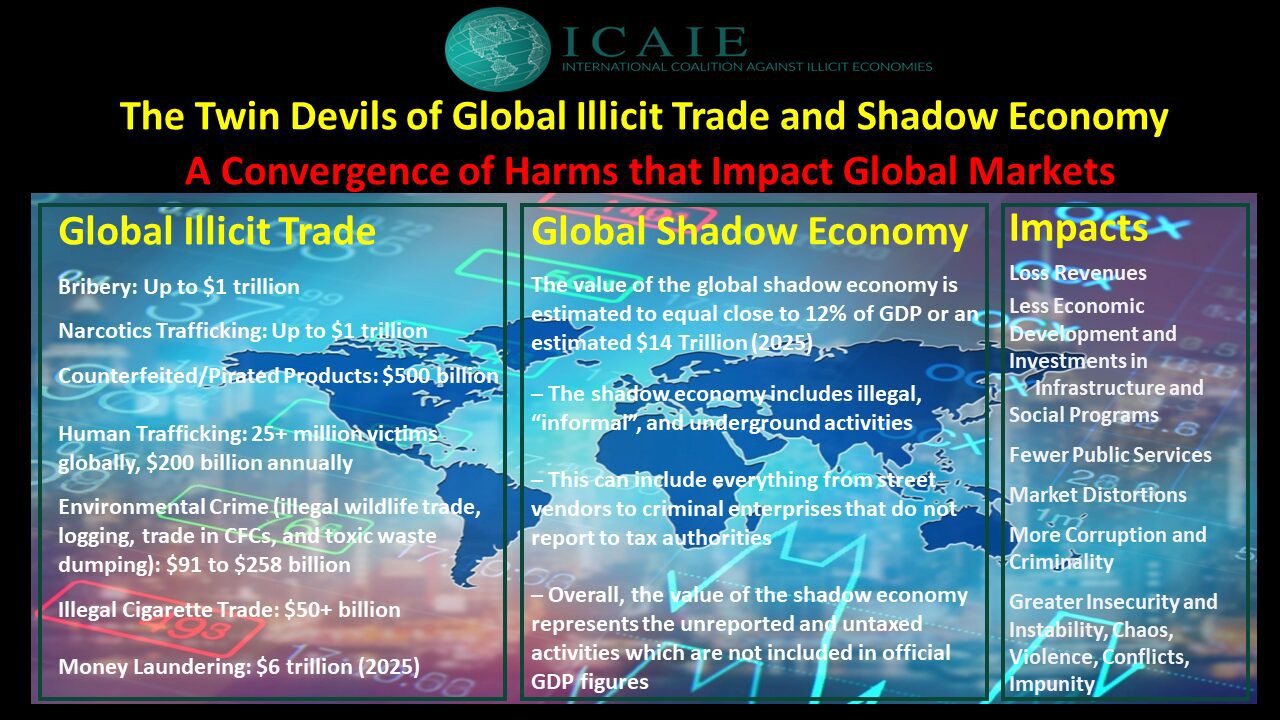
– Bribery: Significant portion upwards of $1 trillion
– Narcotics Trafficking: $750 billion to $1 trillion
– Counterfeited and Pirated Products: Close to $500 billion
– Human Trafficking/Force Labor: $200 billion annually
– Environmental Crime (illegal wildlife trade, logging, trade in CFCs, and toxic waste dumping): $91 to $258 billion
– Illicit Cigarette Trade: $40 to $50 billion; Other Illegal Tobacco Products: tens of billions of dollars more: illegal and counterfeited vapes/e-cigs/nicotine pouches
– Money Laundering: $3 to $6 trillion.
It is a reality that Illicit trade is becoming even more profitable for bad actors and threat networks who are exploiting digital assets, online marketplaces, and trade finance fraud to expand their illicit empires and move “dirty money” and goods across the global trading system.
Moreover, drug cartels, transnational criminal organizations (TCOs), and terrorist financing enablers continue to diversify into numerous illicit markets and across formal sectors.
Money launderers and criminal enablers are very nimble and adaptive and are constantly finding more ways to reinvest filthy lucre into the legitimate global economy.
The value of the global shadow economy is estimated to equal close to 12% of GDP based on a recent analysis of 131 countries by Ernst & Young (EY Global “Shadow Economy Exposed” Report, March 2025), IMF, Visual Capitalist; [ICAIE used 2025 IMF GDP $117T data for estimates in infographic below]:
– The shadow economy includes illegal, “informal”, and underground activities.
– This can include everything from street vendors to criminal enterprises that do not report to tax authorities.
– Overall, the value of the shadow economy represents the unreported and untaxed activities which are not included in official GDP figures.
Illicit trade and shadow economies diminish revenue for economic development by siphoning off hundreds of billions in tax revenues to governments’ Treasuries, crippling public services, distoring markets, fueling corruption, and draining needed resources from legal economies to invest in infrastructure, sustainable economic development programs, healthcare, housing, education, law enforcement, social stability, and better futures.
#EverythingIsConnected
