
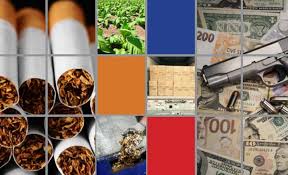
Why illicit cigarettes, nicotine pouches, and illegally-manufactured tobacco products (vapes/e-cigs) continue to be lucrative globally for criminals and other threat networks
Greed begets criminality.
Illicit trade enables criminals to use their dirty profits to not only build their illicit wealth but to finance a greater cycle of greed crimes that destabilizes communities around the world.
From Chile to Panama, South Africa and Australia to across North America, Europe and South Asia, criminals, terrorists, and smuggling networks continue to thrive across hubs of illicit trade for drugs, counterfeits, humans, weapons, gold, wildlife, and other illicit goods and contraband. The trade in illicit cigarettes and other illegal tobacco products also continues to be a criminal activity that attracts a potpourri of bad actors and threat networks, further enabling their market penetration and infiltration of governance institutions.
Several years back, when I was a diplomat with the U.S. Department of State, and an INL Anti-Crime Director, our anti-illicit trade team released The Global Illicit Trade in Tobacco: A Threat to National Security. This report highlighted how the illicit trade in tobacco is a low-risk, high-reward, and often transnational criminal activity that yields lucrative financial windfalls for criminals and terrorist groups alike, serving as a revenue source to potentially finance greater acts of terror and violence.
The U.S. inter-agency team working on this important national security report stressed how the illegal tobacco trade deprived governments of tax revenues, causing billions of dollars in losses annually. At that time, the OECD had also estimated an annual global loss of tax revenues at about $40-50 billion a year from such criminality, representing at least 10% of global consumption. It would be great to have a newer global assessment of the current impacts and harms of the illegal tobacco trade to governments and markets alike.
For example, as we are increasingly seeing in North America, thriving illicit cigarette markets are providing easy money for the Mexican cartels in Canada as they muscle their way into tribal communities in First Nations. Moreover, the Royal Canadian Mounted Police (RCMP), Canada Border Services Agency (CBSA), and provincial law enforcement agencies have had significant seizures in 2025 and 2026, totaling hundreds of millions of illegal cigarettes and other illegal tobacco products with an estimated street value worth over $1 billion.
In the United States, the rise in popularity of nicotine pouches has led to an increase in illicit and counterfeit products entering the market. These fake products, often produced overseas in manufacturing hubs such as in China, are frequently sold at local gas stations, smoke shops, or through unverified online retailers. The counterfeit and illicit e-cigarette/vapes market has grown into a multi-billion dollar global industry, also driven largely by unauthorized manufacturing in China, which produces over 95% of the world’s e-cigarettes/vapes.
ICAIE has also reported on how the trade in illegal tobacco funds other transnational criminal groups in markets like South Africa where such crime converges with the illegal gold trade and other criminality, or across South Asia (e.g., Afghanistan), where terrorist groups derive millions of dollars from illicit cigarettes to finance their operations, logistics, and infrastructure.
In Europe, we have seen recent investigations and reports from Europol and the European Anti-Fraud Office (OLAF) on how the illicit trade in tobacco has had a significant financial impact on the European Union (EU) and its member states, including through illicit manufacturing of cigarettes within EU countries. The European Commission put the financial losses of the EU and its member states due to illegal tobacco products at over €13 billion. These losses stem from lost customs duties, value added tax, and national excise duties.
In Australia, the Illegal tobacco trade has created a massive black market, with illicit products accounting for up to 50% of total tobacco sales, estimated at $3.0-4.0 billion in annual excise tax losses, according to the Australian Criminal Intelligence Commission (ACIC).
In South Africa, the illegal market penetration of illegal tobacco products, which are sold at or below the minimum collectable tax (MCT) rates, account for about 75% of total market share and are now sold in three in every four stores in South Africa, making it one of the world’s largest markets for illicit cigarettes sales.
In recent years, Chile has had to confront higher rates of inflation, migration, organized crime, and other social and economic pressures that have driven illicit trade in the country, from counterfeits and opioids to illegal tobacco and alcohol products. As with other goods that are heavily tax-excised, the higher price of legal cigarettes due to the levying of increased taxes has incentivized criminals to offer cheaper alternatives that have flooded the Chilean economy with duty-not-paid (DNP) cigarettes illegally imported or smuggled into the country. Illicit cigarettes from China, India, and other countries in Asia are also entering the Chilean market illegally. 47% of all cigarettes consumed in 2023 were illicit, increasing to over 50% in 2024. Over 75% of the illicit cigarettes consumed in 2023 in Chile were produced in Paraguay.
The Colón Free Zone (CFZ) in Panama – the largest FTZ in the Western Hemisphere – remains a high-risk hub of illicit trade including sanctioned, prohibited, counterfeit, and contraband commodities. The CFZ and Panama City also serve as significant money laundering and trade-based money laundering risk zones. The CFZ is not only a critical transit point for counterfeit goods but also a criminalized hub for illicit cigarettes, supplying an estimated 80% of all illegal cigarettes consumed in Mexico, Central America and the northern countries of South America. CFZ is also connected to other hubs of illicit trade such as the Jebel Ali Free Zone (JAFZA) in Dubai, UAE.
Across these hubs of Illicit trade – especially in Free Trade Zones (FTZs) – the illegal tobacco trade continues to expand a global ecosystem of criminality, and to spur increased violence, corruption, and dangerous entanglements as criminals and other threat networks fight over illicit pathways to move illegal goods and other contraband resulting in a convergence of transnational threats that has evolved to become more complex, volatile, and destabilizing.
We must continue to fight the illegal tobacco trade, crime convergence, and related corruption and money laundering. We must also encourage greater information-sharing across sectors, improve monitoring systems and transparency across hubs of illicit trade, and strengthen law enforcement capacities and capabilities to fight criminalized trade.
Effective legal, regulatory, governance, and customs measures can also help better monitor cross-border illicit trade and bring greater transparency in the supervision, control, and inspection of risky hubs, ports, and FTZs. At the same time, these efforts will help to stem and prevent illicit trade, money laundering, and the financing of corruption, organized crime, and terrorism in all markets where criminalized trade is imputed through their jurisdictions.
Finally, dynamic public-private partnerships are indispensable to mitigate the risks and challenges associated with illicit trade internationally, and to disrupt and dismantle today’s criminal threat networks. PPPs are further critical for security because they combine government resources with private sector agility, tech expertise (AI, data analytics), and other innovations for stronger, more comprehensive, resilient, and unified defenses against modern security challenges and illicit trade threats, and for the protection and safety of all communities.
David M. Luna is the Executive Director of the International Coalition Against Illicit Economies (ICAIE) and a former U.S. diplomat and national security official charged with strengthening international cooperation and public-private partnerships on fighting crime convergence threats including the inter-connected links between drug cartels, transnational criminal organizations, illicit trade networks, terrorist groups and related corruption and money laundering. Mr. Luna is also the Co-Founder of the Illicit Shadows investigative docuseries illuminating the dark forces shaping the global criminal underworld, which recently launched the new online Museum of Illicit Shadows (MIS).
