Today’s War Profiteers and Merchants of Violence Make Billions of Dollars from Armed Conflicts and Human Bloodshed
Is there a global conflict-crime nexus?
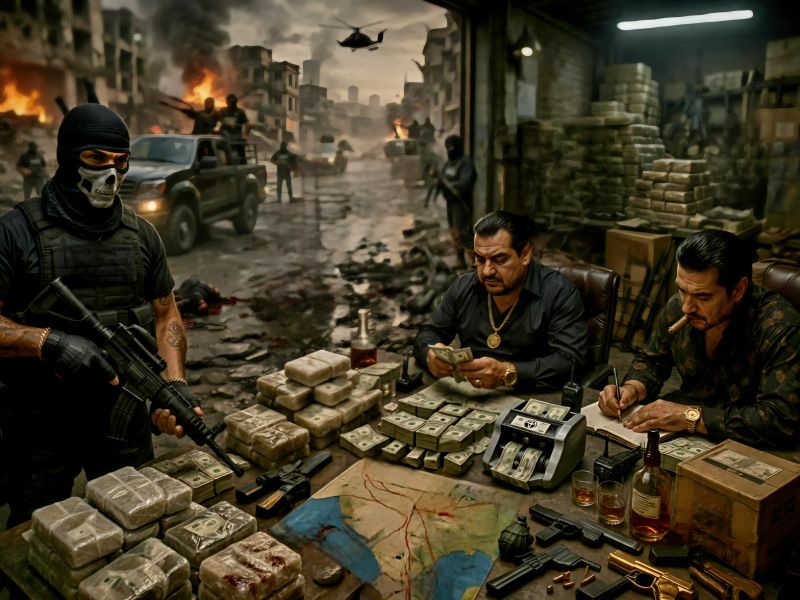
Bad actors and threat networks not only expand today’s global illegal economy; kleptocrats, illicit traffickers, transnational criminal organizations, criminal entrepreneurs, and greedy enablers, et al, also profit from wars, armed conflicts, and fomented violence around the world.
Tens of billions of dollars are made every year by bad actors and threat networks who exploit geopolitical insecurity and create lucrative black markets to sell and buy an array of weapons, drugs (narco-finance, e.g., heroin), illicit goods, contraband, sanctions evasion, conflict finance (e.g., pillaging of diamonds, gold and critical minerals), cybercrime/cyber hacking (see hacking of FBI Director’s personal email this week), and even bribes to obtain “strategic intelligence” (or secrets) to use against adversaries; or “inside information” to manipulate stock exchanges or future markets.
Government officials also engage in war profiteering including through corruption, embezzlement, and fraud (e.g., phantom invoices or overbilling for weapons and other war materiel, for example, in the current Russia-Ukraine war).
Many of the biggest cartels, mafias, syndicates, and other transnational criminal groups profit from global wars’ insecurity and instability through thriving black markets.
Some criminal groups and proxies are contracted for covert or kinetic operations. Recent arrests and foiled plots from North America to Europe to Australia reveal how the Islamic Revolutionary Guard Corps (IRGC) and Iran’s Ministry of Intelligence recruit criminals-for-hire to carry out surveillance, assassinations, and terror attacks.
An 2021 report by The Global Initiative Against Transnational Organized Crime (GI-TOC) highlighted how some of the highest-scoring countries for criminality in their OC Index – meaning those with the most pervasive criminal markets and influential criminal actors – the overwhelming majority were countries experiencing conflict or fragility.
Of course in the past 2-3 decades, we have seen trafficking and smuggling operations by criminals, armed militias, terrorists, and illicit power structures increase tremendously in past wars in Afghanistan, Bosnia, Chechnya, Iraq, Colombia, Myanmar, Gaza, Ukraine, and across the Sahel in Africa.
For example, criminal groups and criminal entrepreneurs in Bosnia profited extensively from the 1992-1995 war, primarily through smuggling networks, black market operations, and the diversion of international and humanitarian aid. These activities were crucial to sustaining various military factions and led to the rise of new economic and political elites who often maintained their criminal and corruptive influence after the conflict.
During the Chechnya war, various groups and individuals on all sides profited from the chaos, insecurity, and lack of institutional control through widespread criminality. This included Chechen rebels, Russian forces, Chechen mafia, and an array of other Eurasian criminal networks and smuggling rings.
In the Afghanistan war, various criminal and armed groups, including the Taliban, profited significantly from the instability and chaos in the country, leveraging the conflict to engage in and expand illicit economies including opium poppy cultivation and the trafficking of opiates (heroin) and methamphetamine; and the illegal excavation and smuggling of natural resources and critical minerals like chromite, marble; lithium and other rare earth elements.
In the last war in Iraq, various criminal groups, including militias and insurgent organizations extensively profited from the conflicts through a wide range of illicit activities including oil smuggling, extortion and protection racketeering, kidnapping for ransom, human trafficking, the illicit cigarette trade, and smuggling and trade in stolen antiquities, for example.
In Gaza, criminal gangs continue to profit significantly from the war, primarily through their smuggling operation and by looting humanitarian aid and reselling it on the black market at exorbitant prices. This situation continues to excerbate the human misery in Gaza, fueled further breakdown of civil order, and has created illicit power structures.
Criminal groups often profit from sanctions by controlling black markets, smuggling goods, and providing sanctions-evasion services, capitalizing on the disruption of legitimate trade. Sanctions create high-demand shortages and restrictive environments that increase the profit margins for smuggling, money laundering, and illicit trade networks, acting as a catalyst for criminal economic activity including in times of wars and armed conflicts.
In the war in Colombia, the Fuerzas Armadas Revolucionarias de Colombia (FARC) and the currently active Ejército de Liberación Nacional (ELN) derive significant profits from a variety of criminal activities, with the drug trade, illegal mining, extortion, and kidnapping being their primary sources of income.
In Venezuela, in the aftermath of U.S. special operations to capture Nicolás Maduro, it did not eliminate his criminal regime who continue to be in power and profit from drug trafficking and other illicit activities. The Maduro regime now led by his former Vice President, Delcy Rodríguez, is a “criminalized state” or “mafia state,” where government institutions have merged with organized crime to maintain spower. Under the Maduro regime, the state facilitated drug trafficking, illegal mining, money laundering, and severe human rights abuses, with Venezuela serving as a regional hub for organized crime.
In Ukraine, after Russia’s invasion of the country, numerous Russian and Ukraine criminal networks, private military companies (PMCs), and other transnational criminal organizations, have helped to expand cross-border illicit economies despite Western sanctions, creating new illicit markets, trafficking routes, and illicit supply chains. These groups engage in a variety of illicit activities, including arms and drug trafficking, cyberfraud, and siphoning off humanitarian or reconstruction funds. Some military officials in both Ukraine and Russia have also been investigated for embezzlement of defense procurement funds to support the war on each side. The Wagner Group, a Russian state-affiliated paramilitary organization (now largely rebranded as the “Africa Corps”) and which operates under Russia’s Ministry of Defense, has been widely documented as a significant transnational criminal organization that profits from war. The notorious PMC has funneled vast sums from the exploitation of natural resources in African nations to help fund Russia’s war effort in Ukraine.
War usually leads to a shortage in the supply of commodities, arms, and other goods and services (overcharging) in large demand — which results in higher prices and higher revenues for such market stakeholders and illicit actors alike.
For example, it has been reported that in recent years many states often profit handsomely when the price of certain commodities skyrocket (e.g., oil and gas) and are incentivized to prolong some conflicts to fill their national coffers, or officials lining their pockets in authoritarian regimes. Although I have mostly focused on illicit actors, some reports have also brought attention to the profit motives of major modern defense conglomerates, and across other industries, and their corruptive influence in times of war and armed conflicts.
So yes, it is a reality that an array of bad actors, threat networks, and industry-wide contractors profit lucratively from wars and conflicts.