
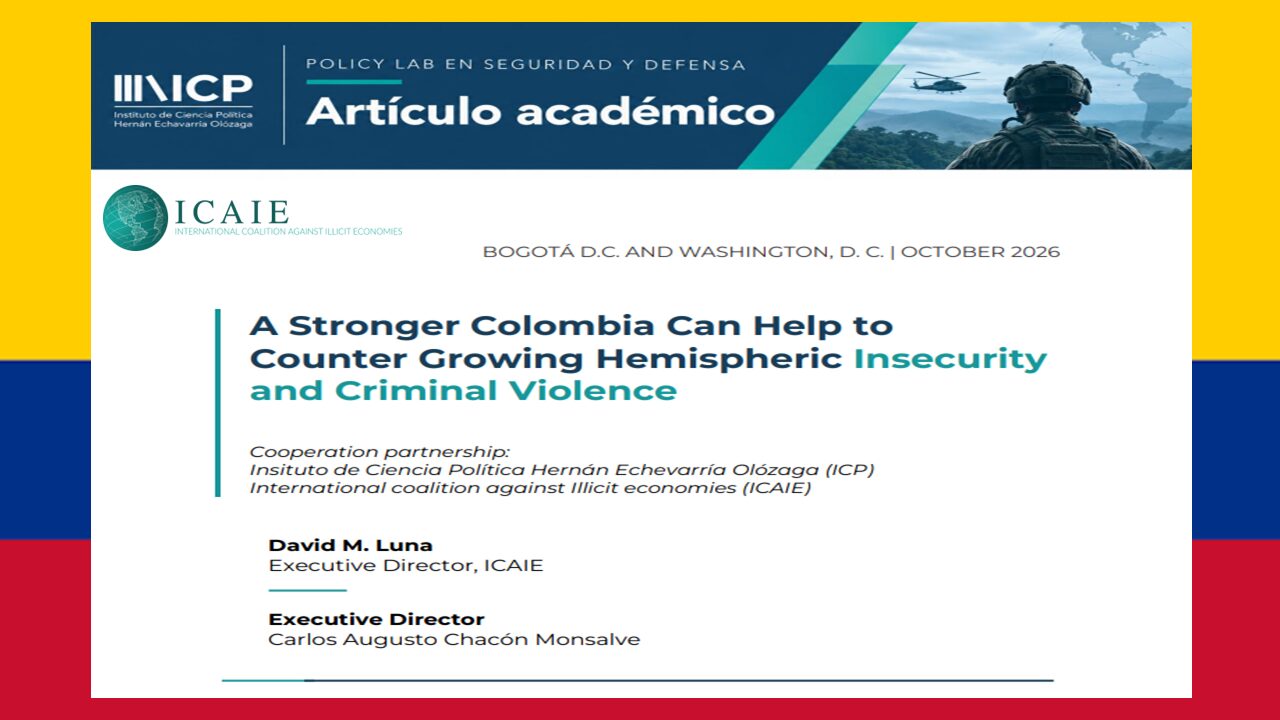
A Stronger Colombia Can Help to Counter Growing Hemispheric Insecurity and Criminal Violence
Cooperation Partnership: A Joint Article by the Insituto de Ciencia Política Hernán Echevarría Olózaga (ICP) and the
International Coalition against Illicit economies (ICAIE)
David M. Luna
Executive Director, ICAIE
Carlos Augusto Chacón Monsalve
Executive Director, ICP
Published by Policy Lab En Seguridad y Defensa, OCTOBER 2026
www.icpcolombia.org
INTRODUCTION
The Instituto de Ciencia Política Hernán Echavarría Olózaga (ICP) publishes this paper by David M. Luna within the framework of the cooperation partnership between the International Coalition Against Illicit Economies (ICAIE) and the ICP, aimed at strengthening analysis and policy proposals regarding transnational organized crime, illicit economies, and emerging security threats in Colombia and across the hemisphere.
The paper, A Stronger Colombia Can Help to Counter Growing Hemispheric Insecurity and Criminal Violence, offers a particularly relevant approach to understanding the transformation currently reshaping the regional security environment. Its main contribution lies in moving beyond a fragmented reading of different illicit economies and criminal organizations and instead analyzing them as part of a single ecosystem of criminal convergence. Drug trafficking, illicit gold extraction, smuggling, arms and human trafficking, counterfeiting, money laundering, and other illicit activities do not necessarily operate as separate markets. Increasingly, they share routes, logistics infrastructure, facilitators, financial mechanisms, corruption networks, and institutional vulnerabilities.
This perspective directly aligns with one of the key approaches that the ICP Policy Lab on Security and Defense has been advancing. Contemporary criminal structures must be understood as adaptive networks, capable of diversifying their sources of financing, rapidly replacing lost nodes, modifying their routes, penetrating legal economic activities, and exploiting failures in state coordination. For that reason, targeting individual organizations, leaders, or illicit revenue streams may produce important operational results, but it rarely changes the functioning of the criminal system on a lasting basis.
Luna’s analysis shows why the strategic objective must go beyond increasing seizures or arrests. The priority should be to systematically reduce the power of criminal networks by simultaneously disrupting their finances, infrastructure, logistics, corridors, facilitators, corruption mechanisms, and areas of territorial control. This requires moving from an approach focused primarily on fighting individual crimes toward a strategy aimed at dismantling criminal networks and illicit value chains.
In his EXECUTIVE SUMMARY, Mr. Luna states:
Since assuming power in August 2026, President Abelardo de la Espriella has made the fight against organized crime and illicit trade a top national security priority, as Colombians have decried the growing violence and criminality in their country. Similarly, in recent years across the Americas, other Latin American governments have had to grapple with rising crime in their countries. Hemispheric threats are real and growing, as agile criminals and threat networks destabilize the region, exploit governance weaknesses, and leverage border vulnerabilities to generate tens of billions of dollars in revenue. Whether in Colombia or in other countries in the region, organized crime and illicit trafficking networks are infiltrating governance institutions and penetrating markets to assume greater power and wealth.
Drawing on Colombia’s hard-earned experience confronting narcocorruption and the Medellín and Cali drug cartels, it should once again provide demonstrable regional leadership by joining the United States, and other committed partners, in fighting narco-terrorism and cross-border threats. Today’s challenge, however, is more complex and interconnected, as transnational organized crime, designated terrorist organizations, illicit trade networks, corrupt facilitators, and money launderers increasingly exploit overlapping trafficking routes, logistics infrastructure, financial channels, and border vulnerabilities. Colombia can help lead a new generation of regional cooperation build around intelligence sharing, joint investigations and operations, financial disruption, and coordination action against these interconnected threats.
Find the full artículo académico in English and Spanish below:
