
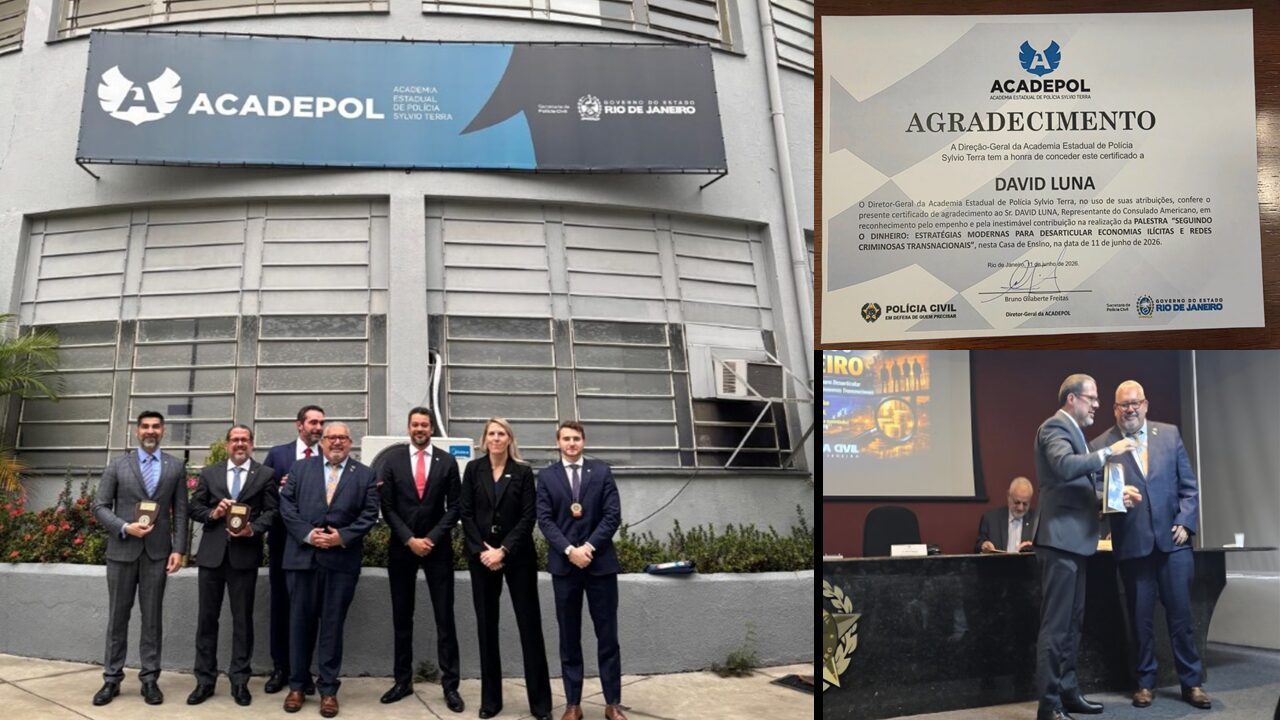
Following the Money: Modern Strategies to Disrupt Illicit Economies and Transnational Criminal Networks – ICAIE Remarks, ACADEPOL, Rio de Janeiro, 11 June 2026
FINAL Prepared Statement and Key Points
Following the Money: Modern Strategies to Disrupt Illicit Economies and Transnational Criminal Networks
David M. Luna
Executive Director
International Coalition Against Illicit Economies (ICAIE)
Rio de Janeiro, Brasil
11 June 2026
¡Bom Dia!
It is an honor to return to Rio de Janeiro and to be here with you this week at this important dialogue and series of meetings in Brasil including at the Universidade de São Paulo’s 2026 International Seminar: Market Capture and the New Frontiers of Transnational Crime in the Americas.
I would like to thank the Academia de Polícia Civil (ACADEPOL) for hosting and moderating this event especially Dr. Bruno Gilaberte Freitas and Dr. Wilson Luiz Palermo Ferreira. I would also like to thank the U.S. Consulate Rio de Janeiro, and the U.S. Department of State’s Bureau of Educational and Cultural Affairs, and the “U.S. Program on American Leadership in Foreign Policy and National Security” for supporting this important Transnational Crime series with partners such as the Government of Brasil and the State and local leaders here in Rio such as the civil and military police and prosecutors.
Finally, I would also like to thank the numerous Brazilian public and private sector partners with whom I have had the distinct pleasure of working over the years in my prior capacity at the U.S. Department of State on global security issues, bilaterally, in numerous multilateral fora, and now as a private citizen.
This morning, I will provide some personal insights as a global expert on transnational security threats. In particular, I would like to focus on four areas:
1) the growing harms posed by violent gangs and criminal networks;
2) the global illegal trade and illicit economies;
3) their impacts to governance institutions, markets, and broader communities; and
4) how dirty funds finance a cycle of violence and instability.
Ladies and gentlemen: Both organized crime and illicit trade have significant costs and impacts to democracy, economic growth, the rule of law, and shared prosperity.
Illicit trafficking remains the lifeblood of today’s bad actors, criminal organizations, and terrorist groups.
Through dirty money derived from criminality, these malefactors finance corruption, chaos, insecurity.
While illicit trade is a global phenomenon, inter-connected hemispheric criminalities have significant touch points with Brasil that also pose greater risks to businesses and government alike here in Rio.
Make no mistake. The illegal trade and contraband that we read about or see on the news daily are also destabilizing threats in Rio, across Brasil, and across borders.
Convergence Crime: Illegal Trade and Illicit Markets
As we know, globalization has enabled and provided opportunities for criminals and their networks to expand the scope and scale of their operations.
In a world of convergence, the risks and threats associated with illegal trade are inter-linked in many ways – each individually dangerous, but whose sum represents a far greater threat across borders.
As threat multipliers, what happens in one market impacts many others. One illicit threat spawns many other harms.
No country, no region, no community is untouched by the corruptive influence of global crime, and exploitative bad actors and illicit networks.
We also need to realize how sophisticated criminal entrepreneurs are diversifying their portfolios and trafficking everything from narcotics, people, arms, endangered natural resources to fake medicines, electronics, apparel, and illicit cigarettes and alcohol products in places like the Triple Frontier along the junction of Argentina, Brasil, and Paraguay.
But their diversification also helps to infiltrate governance institutions and penetrate legitimate sectors.
Through such black markets, we begin to recognize how dirty money derived from these crimes are laundered and reinvested into the formal economy.
Similarly, bad actors use criminally-derived proceeds to traffick in violence, buy impunity, and corrupt police, security, and law enforcement institutions that are responsible for keeping people safe, thus eroding the public trust.
Greed Crimes and Shadow Economies
Let me share how expansive many of these criminalized (illicit) markets are internationally within this global illegal economy.
In 2025, the International Monetary Fund (IMF) projected that the Global GDP was estimated to reach approximately $117 Trillion in nominal terms.
According to ICAIE’s own research in the past several years, the global illegal economy, consisting of an array of illicit markets and illicit financial flows, could account for 2–5% of global GDP, amounting to up to $6 trillion annually in 2025. A staggering amount!
The lucrative multi trillion-dollar global illicit economy includes an array of cybercrimes as well as the smuggling and trafficking of drugs, opioids, weapons, humans, counterfeit and pirated goods; illegal tobacco and alcohol products; illegally harvested timber, wildlife and fish; pillaged oil, diamonds, gold, natural resources and critical minerals; and other illicit commodities and contraband. Some examples of the staggering profits of illicit activities include:
– Bribery: Significant portion upwards of $1 trillion
– Narcotics Trafficking: $750 billion to $1 trillion
– Counterfeited and Pirated Products: Close to $500 billion
– Human Trafficking/Force Labor: $200 billion annually
– Environmental Crime (illegal wildlife trade, logging, trade in CFCs, and toxic waste dumping): $91 to $258 billion
– Illegal Cigarette Trade: $40 to $50 billion
– Money Laundering: at least $3-6 trillion.
While it is true that the United States has proposed a 25 percent tariff on a broad range of Brazilian imports after a trade investigation by the U.S. Trade Representative (USTR) office found the country had engaged in unfair trade practices that imposed economic harms on American business, and while there are ongoing trade talks, I do think that Brazil needs to do more to enforce intellectual property rights, fight illicit trade, and counterfeits such as the fake medicines and illegal cigarettes flooding the country.
It is a reality that illicit trade is also booming in the digital world as criminals are exploiting digital assets, online marketplaces, and engaging in trade finance fraud online, including via social media.
Money launderers and criminal enablers are very nimble and adaptive and are constantly finding more ways to reinvest their filthy lucre into the legitimate global economy.
Of course, within the shadow economy, tax evasion, smuggling, and untaxed underground criminal activities further complicate good governance practices to raise the revenue necessary to fund an array of social services, economic development, and security measures.
Now moving from global landscapes to more regional and national scenarios.
Today, South America is an inter-linked hub of convergence crimes that facilitates the laundering of tens of billions of dollars in illicit profits for drug cartels, transnational criminal organizations (TCOs), violent prison gangs, terrorist financiers, and other extra-regional threat networks.
From the expansion of the Mexican cartels’ illicit businesses in South America to the cocaine traffickers in Colombia and Venezuela to extra-regional criminal networks’ presence in Andean markets of Bolivia, Chile, Ecuador, and Peru, as well as along the Atlantic-Caribbean criminalized corridors in Argentina, Brasil, Guyana, and Suriname illicit superhighways are financing insecurity that destabilizes efforts to effectively combat organized crime and illicit trade.
Another important reality is that TCOs in Latin America are undergoing a significant transformation, driven by fragmentation of older criminal networks being replaced by newer alliances with extra-regional actors and supported by ideologically flexible authoritarian governments.
These include important networking relationships among Latin American TCOs such as the Primeiro Comando da Capital (PCC) and the Red Command (Comando Vermelho) in Brasil with the Italian ‘Ndrangheta, and inter-regional joint criminal ventures involving Balkan and Eurasian trafficking mafias and syndicates and Chinese triads, in addition to other extra-regional groups now firmly rooted in the hemisphere.
As illicit trade continues to accelerate in South America and connect to all corners of the world, bad actors and criminal networks leverage vulnerabilities in today’s global trading system, disruptions in supply chains, governance gaps, and weak law enforcement regimes.
In this climate of insecurity, the drug cartels and other TCOs in Latin America have greater power, political influence, and tremendous illicit wealth.
Everything is connected.
Transactional Laundering Convergence in Drugs, Gold, and Oil
Take for example, the criminal gold rush in South America that has been underway in the past decade, as illicit networks diversify and seek greater riches in precious metals and critical minerals.
In Venezuela, numerous bad actors have been quite active in plundering illegal gold mines for their own enrichment.
So lucrative is illegal gold mining in the country that sistemas are also reaping great rewards. These are criminal and armed guerilla groups in Venezuela and neighboring Amazonas states and other narco-states in Latin America. including the Mexican and Colombia cocaine cartels, Revolutionary Armed Forces of Colombia (FARC) and the National Liberation Army (ELN), and they are cashing in on illicit gold.
The gold rush has incentivized these threat networks to also expand to Guyana, Peru, and Chile in search of new riches.
Through porous borders or official borders in which officials are bribed, a confluence of illicit pathways enables the comingling and laundering of the profits from narcotics trafficking with those derived from illegal gold mining.
In fact, gold laundering is used by criminals and other bad actors to move illicit proceeds through an array of trade and customs fraud schemes, including the use of fraudulent certificates of origin.
Illegally-mined gold can also be laundered through use of processing plants working with intermediaries who produce fraudulent purchasing documents or through buying up stakes in gold mines and using the bank accounts of gold companies.
Illegal gold moves in all directions via numerous trafficking and smuggling routes.
In Peru – Latin America’s number one producer of gold – refineries in Lima can get illegal gold moved from the capital to Miami, Dubai, Zurich, Mumbai, and other gold trading markets.
Similarly, in several law enforcement operations, Brazilian authorities arrested criminal smugglers from Itaituba, in the Tapajós River, basin who were using boats, ferries, planes, and other land vehicles to smuggle gold from Brasil to Venezuela, and selling it onwards across international markets in the United States, Switzerland, UAE, and other countries.
Often licit and illicit gold is used to launder the dirty monies derived from drug trafficking, illicit cigarettes, and other criminal activities.
Criminal Expansion into Critical Minerals and Natural Resources in South America
In addition to the profits from illegal gold mining operations, and the fact that South America is exceptionally rich in natural resources, criminal groups are similarly gravitating to expand their illicit wealth by pillaging its vast biodiversity ecosystems, critical minerals, oil, and endangered species.
In Brasil, the PCC has transformed itself over the past three decades from a prison gang founded in São Paulo into a transnational criminal “leviathan,” with a presence throughout South America, Africa, and Europe.
In its earlier days, the PCC focused on the cocaine trade and counterfeits from the tri-border area.
In the past decade, the PCC and other criminal gangs from Brasil, Colombia, and Peru have become key players in the Amazon’s sub-regional criminal economies involving narcotics, illegal gold mining, timber, and critical minerals.
Routes used by drug traffickers have also been used to facilitate the movement of illicitly mined and harvested sensitive environmental-green products.
The PCC is actively involved in the illegal gold mining and timber industries, controlling swaths of territories in the Amazon and operating with great impunity.
In these areas with weakened law enforcement and lawlessness, the PCC also thrives on profiting from prostitution, arms trade, and other criminal rackets.
The environmental and human security impacts have been devastating in PCC-controlled areas in Northern Brasil, including mercury-polluted rivers, starvation, and increased murders and deaths.
The Tri-Border Area (TBA) remains a key hub of illicit trade where a complex web of criminal and terrorist financing networks operates to advance numerous illicit activities with an economy believed to be worth approximately $10 billion.
Due to the inadequate state regulation of the TBA, organized crime has a vital outlet for transporting unlawful goods and services. For example, it is estimated that billions of cigarettes are smuggled via the TBA each year, equating to over a billion dollars in lost potential Paraguayan tax revenue.
The majority of illicit profit is assumed to be used to finance threat networks such as Hezbollah, the PCC, the CV, and other threat networks..
The subregion’s expansive network of ports free-trade zones, and transportation pathways also provides entry and exit points for illicit goods into international markets. Corruption and money laundering are rampant in these hubs of illicit trade Free Trade Zones (FTZs) and maritime ports like the Ports of Santos, Rio Grande, and Rio de Janeiro.
Extra-Regional Criminal Market Players: The Mexican Cartels, Chinese Triads, Eurasian Mafias Cash in on the Gold Trade in South America
From a trans-regional perspective, the fragmenting and realigning of organized crime operations across borders has also seen the rise of Eastern European, Chinese, Turkish, Italian ‘Ndrangheta, and Balkan syndicates vying for market share in Latin America; and, reciprocally, increased illicit business by the cartels, the Primeiro Comando da Capital (PCC), the Red Command (Comando Vermelho – CV), and other Latin criminal networks in lucrative markets in Europe and overseas.
The Mexican cartels continue to expand their operations across Latin America.
Ecuador, once among the most peaceful countries in Latin America, faces an existential threat from an array of violent gangs and extra-regional criminal networks including the Sinaloa cartel and Cartel Jalisco New Generation (CJNG).
Because of these regional networked criminal alliances, communities are not safe in this climate of fear.
These groups continue to co-opt governments at the federal, state, and local levels, and finance their impunity through bribery, corrupting of public officials at all levels, corroding rule of law institutions, and creating a climate based on fear.
Extreme violence and strategic corruption put politicians at the mercy of the networked alliances involving cartels and TCOs, and allow these criminal groups to take control of the fundamental government structures and expand their criminal agendas in all spheres of society.
As a result, the PCC, Mexican cartels, and other regional TCOs will continue to diversify and exploit illicit economies to grow their international criminal enterprises through new income streams, and continue to undermine governance structures through bribery and intimidation to control more illicit markets and ports by means of a network of global criminal alliances. Of course, as we learned in the multibillion dollar money laundering scheme in Operação Carbono Oculto, the PCC has diversified and infiltrated major sectors of the Brazilian economy including energy (oil and gas stations), fintech, manufacturing, logistics, construction, transportation, and others.
This includes through their corruptive influence in penetrating strategic markets and critical infrastructure such as maritime ports and free trade zones (FTZs). The megaport in Chancay, Peru is already a gateway for counterfeits and criminalized trade which is expected to accelerate through the 5,000 km transcontinental rail corridor stretching all to way to Brazil’s Atlantic coast.
Rising Destabilization in Rio
Here in the State of Rio, the Comando Vermelho (CV) continues to create insecurity through violence, robbery, kidnapping, weapons trafficking, extortion in numerous sectors such as the internet, gas, and transportation, and other crimes in the favelas, and across the city. The result is that it is increasingly difficult for government officials and police to access these areas.
The CV has grown into a sizable national and transnational threat, expanding its criminal activities not only in the northern state of Amazonas and the western state of Mato Grosso, but also maintaining narco-trafficking and illicit operations in Paraguay, Bolivia, and other parts of the continent such as with Colombia’s FARC.
In addition to the Red Command, other militias and criminal gangs are also thriving in numerous illicit markets in Rio including the Pure Third Command (Terceiro Comando Puro – TCP).
As many of you have witnessed in recent years, these gangs fight over territories and lucrative routes for trafficking and smuggling of illicit goods and contraband.
Of increasing concern is the CV’s corruptive influence in the political arena through vote-buying, coercion, intimidation, and the funding of political candidates. Additionally, the CV’s growing sophistication in fintech, logistics, digital technologies is used for surveillance, extortion, coercion, information control, money laundering, cyber theft and fraud, electronic embezzlement, and for leveraging cryptocurrencies to advance their ecosystem of criminality.
On May 28, the U.S. Department of State designated the PCC and the Red Command as foreign terrorist organizations (FTOs) and Specially Designated Global Terrorist (SDGTs) as the United States has done with regard to the Mexican cartels and other Latin criminal gangs. Such a designation will impose financial sanctions on these criminal networks, their enablers, and co-conspirators who provide “material support”.
More specifically, the implications for Brazilian businesses such as banks, fintechs, payment processors, and in other industries and sectors – particularly those operating internationally or imputing the U.S. financial system – may entail higher compliance scrutiny and related risk mitigation actions such as revising AML controls and risk management strategies given the reality that the PCC and CV have infiltrated legitimate industries and global supply chains.
As a national security professional, I do believe that a more robust, full spectrum approach where a government leverages all instruments of national power is critical to fight today’s violent criminal networks, especially when undertaken under the rule of law and invocations of financial sovereignty considerations.
Finally, I welcome the continued bilateral cooperation and exchanges that are occurring, aimed at combatting money laundering related to narco-trafficking by criminal networks in Brasil based on mutual trust and respect.
Money Laundering and Threat Finance
Let me say a few words on why targeting money laundering impedes criminals ability to finance more criminality and insecurity.
An estimated $3 to $6 trillion is laundered around the world.
For decades, law enforcement communities have focused a large amount of their energies on targeting kingpins or mafia bosses or specific illegal trafficking transactions of contraband, and directed lesser efforts toward following the illicit money flows and value transfers to dismantle the enabling infrastructure or the financial logistics of the dirty monies associated with such notorious criminal networks.
Over the past few decades, the drug cartels and other Latin TCOs have evolved their ways of laundering their ill-gotten gains from illegal sources through the global banking system and underground banking channels.
For example, in the United States in the past, criminal networks used cash-based schemes to launder their dirty money including through bulk cash deliveries, “structuring” amounts under $10,000 to avoid Bank Secrecy Act (BSA) reporting regulations, and using casinos, and other cash-intensive businesses such as high-value real estate, nightclubs, and restaurants.
Another traditional method used by money launderers was “reinvestment” through the purchasing of physical assets such as fine art, automobiles, yachts, electronics, appliances, and high-end luxury consumer goods including jewelry, apparel, handbags, and footwear.
However, in recent years, criminals have starting employing novel techniques such as trade-based money laundering (TBML), virtual currencies, online marketplaces (transaction laundering), decentralized finance (DeFi), alternative remittance payments (or informal value transfer system), and other leveraged technologies, to bypass traditional money laundering methodologies and formal financial systems.
This allows them to hide, move, and clean their dirty monies through financial offshores, front companies and anonymous shell companies.
Building on the earlier Black Market Peso Exchange (BMPE) often used by Colombian and Mexican drug cartels, trade-based money laundering (TBML) is increasingly utilized by criminals to mis-invoice and exploit weaknesses and vulnerabilities in the global trading system in order to integrate illicit drug proceeds into the legal financial system.
Disguising the proceeds of illegal activities, TBML helps move “value” illicitly across borders by misrepresenting a trade through the export and import of consumer goods or commercial transaction (on an invoice or sale receipt), fraudulently misreporting the quantity, quality, price per unit, or description of a good that results in the shipment being under- or over-invoiced.
The convergence between global trade, the digital economy, and cybercrime has also given rise to newer forms of money laundering.
Bad actors and illicit threat networks are increasingly using e-commerce, social media, and mobile technologies to diversify their criminality.
Among these newer methodologies are the use of digital assets, internet payment services, prepaid calling, stored-value, and credit cards, and mobile payments (M-Payments), which is the use of a cell phone to credit, send, receive, or transfer money or digital value.
It is estimated that by 2030, there will be more than 5 billion mobile phone users and about 50 billion connected devices, creating more opportunities for criminals to profit from illicit trade and to launder their dirty monies.
M-payments involve a process not only to facilitate legitimate financial transactions but a system whereby criminals are using mobile phones to move illegal funds, exploiting the technology’s speed, reach, and anonymity to obscure the origin and destination of dirty money.
In addition to providing greater anonymity, M-payments using banking apps and digital wallets, including using digital currencies such as bitcoin and other cryptocurrencies.
M-Payment and online apps can also create multiple accounts under false identities, use fake businesses to receive payments, and transfer funds across borders, making it difficult for investigators to trace, detect, and prosecute these crimes.
The Money Laundering Networks
Criminal entrepreneurs, money laundering organizations, and professional enablers – including those from within complicit sectors such as accounting, art auction, banking, law, real estate, wealth management, trusts and incorporation service providers – help bad actors and threat networks to launder their illicit wealth by creating anonymous shell companies, financial accounts, and other business structures to move dirty monies, and reinvest them into the legal economy.
Terrorist financiers have long been able to exploit Venezuela and the TBA as financial safe havens to raise and move illicit funds to support Islamic terrorist operations globally.
Other money laundering organizations dominant in illicit finance operations in the Americas include Chinese Money Laundering Networks (CMLNs) that are laundering tens of billions of dollars annually for the drug cartels and other TCOs including in the illegal fentanyl trade.
According to ICAIE, China may very well be the biggest money laundering hub in the world, with Chinese triads among the most profitable transnational illicit trade syndicates.
Chinese money laundering networks also provide fei-chien (“flying money”) and mirror swaps to clean not only drug profits but also for both licit goods and for illicitly-traded counterfeits and illegal goods such as Amazonian gold, timber, critical minerals, and other natural resources.
Drug cartels and Latin TCOs are increasingly using digital currencies and stable coins such as Tether (USDT) to launder their dirty money and layer through anonymous networks of different digital wallets and exchanges before being converted back into fiat currency.
But the sad reality is that only 1% to 2% of illicit financial flows are seized or frozen globally each year; leaving roughly 98% to 99% of criminal profits at the disposal of illicit actors.
To win the fight against these well-funded bad actors and threat networks, it is critical for market stakeholders to adopt holistic, whole-of-society approaches, cross-border and cross-sectoral cooperation and information-sharing mechanisms, and more dynamic public-private partnerships to tackle cross-border illicit trade and related threat finance and money laundering.
This includes the development of specific AML/counter-threat finance policies, technologies, and strategies to prevent and combat money laundering financing illicit trade, identify and recover stolen assets and criminally-derived profits, and a greater focus on newer money laundering trends and methodologies across the digital world and underground banking that bypass traditional financial systems.
Fighting Networks with Networks
So what do we do about these harms and threats?
Action beats reaction. Whoever adapts, anticipates, and acts first gains the strategic advantage. Fostering agile, cross-border information-sharing, intelligence-led policing, and leveraging technologies (e.g., AI and data analytics), for example, can help to outfox criminal syndicates.
How can Rio de Janeiro, São Paulo, and Brasil mobilize greater energies across sectors to fight illegal trade and contraband in this country, regionally, and globally?
I am a firm believer of net-centric synergies: a network of networks where dynamic collaborations, strategic alliances, and collective action can, and are, making a difference as partners work with each other across regions to tackle many of today’s transnational threats.
For the reality is that no one economy or community is immune from these threats, such as corruption or cross-border illicit trade.
Brasil can also help to mobilize greater intra-regional cooperation and information- and intelligence sharing from one hot spot to another within the country, and across this region.
Private sector leadership is also indispensable. Public-private partnerships are strategic alliances that can fight back more forcefully at all levels across security landscapes and through more holistic, multi-dimensional, coordinated courses of action, and smartly leveraged innovative technologies.
As criminals are converging, we too must converge across borders, sectors, and industries.
More cross-border investigations, coordinated law enforcement operations and cross-industry partnerships are needed to not only target threat networks such as the PCC and CV and their facilitators who help to divert, smuggle, and traffick counterfeit and other illicit goods across jurisdictions, markets, and regions, and finance hemispheric insecurity.
There is something to be said about strength in numbers. I think that a continued and strong Brasil-United States cooperative network across law enforcement and security disciplines can be a force multiplier for good, and to safeguard our respective national interests.
Because without collaborative and coordinated responses, drug cartels and other illicit networks will continue to jump from weak spot to weak spot, seeking out and exploiting vulnerabilities, to the detriment of all market stakeholders.
Obrigado!
