
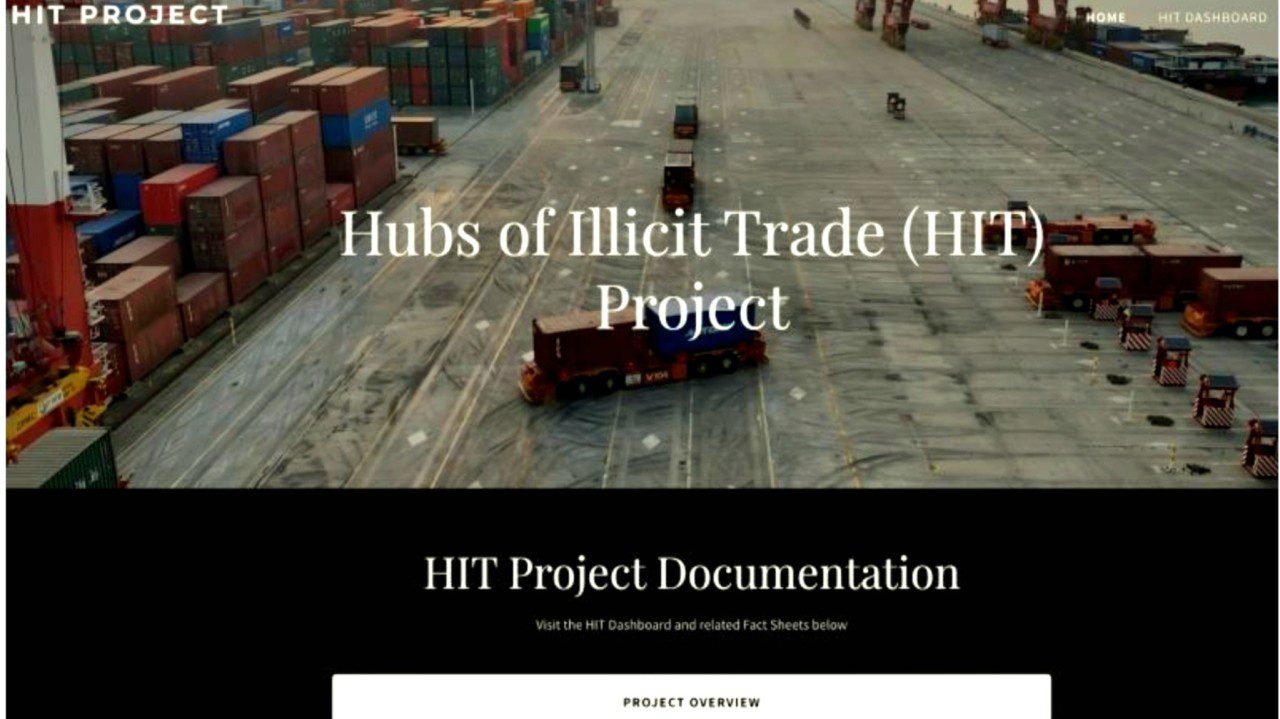
Hubs of Illicit Trade (HIT) Project
Since 2022, an international multi-disciplinary team of experts has been carrying out research on hubs of illicit trade and related risk zones and crime convergence points to help stakeholders better understand how to target and disrupt them.
The first Hubs of Illicit Trade Project (HIT 1) analyzed four well-known hubs of illicit trade to understand their operations, similarities, differences, and impacts.
HIT 2 developed an innovative methodology to map the global ecosystem of illicit trade and several of the specific trades that flow through it.
The illicit trade ecosystem is dynamic and responds rapidly to shifts in market opportunities, political developments and law enforcement strategies.
It is a global business that is difficult to detect because it hides inside the infrastructure of the licit global trading system and becomes almost invisible through the sheer volume of licit trade going on around it.
The best way to identify, track and disrupt illicit trades is to identify the routes, transport modes and enablers that are used at the beginning of the supply chain and help law enforcement and other stakeholders target them before they enter the mainstream.
This is the goal of the HIT program.
Engagement is an integral component of the HIT program, because government, policy and law enforcement stakeholders are the people who can translate our insights into concrete actions to disrupt illicit trades.
The HIT research has attracted the interest of the World Customs Organization (WCO) who invited our team to become the academic partner in Project Octagon, the WCO’s premier AML-CTF initiative.
In 2026, the HIT Team has been invited to brief on this important project with the Egmont Group of Financial Intelligence Units, Financial Action Task Force (FATF), OECD – OCDE, Business at OECD, and engaged with numerous governmental bodies and law enforcement communities including within the United States (U.S. Department of Homeland Security, National Intellectual Property Rights Coordination Center, U.S. Customs and Border Protection, USPTO) and US Congress.
We hope to also socialize the HIT project in the future (2026-2027) with INTERPOL, Europol, European Commission, EUIPO – European Union Intellectual Property Office and other intergovernmental bodies such as UNODC, The ASEAN Secretariat, Organización de los Estados Americanos, APEC, GCC, IMF, World Bank, et al, and with other interested governments, business associations, and civil society organizations.
Learn more about the HIT project at: https://hitproject.org/